




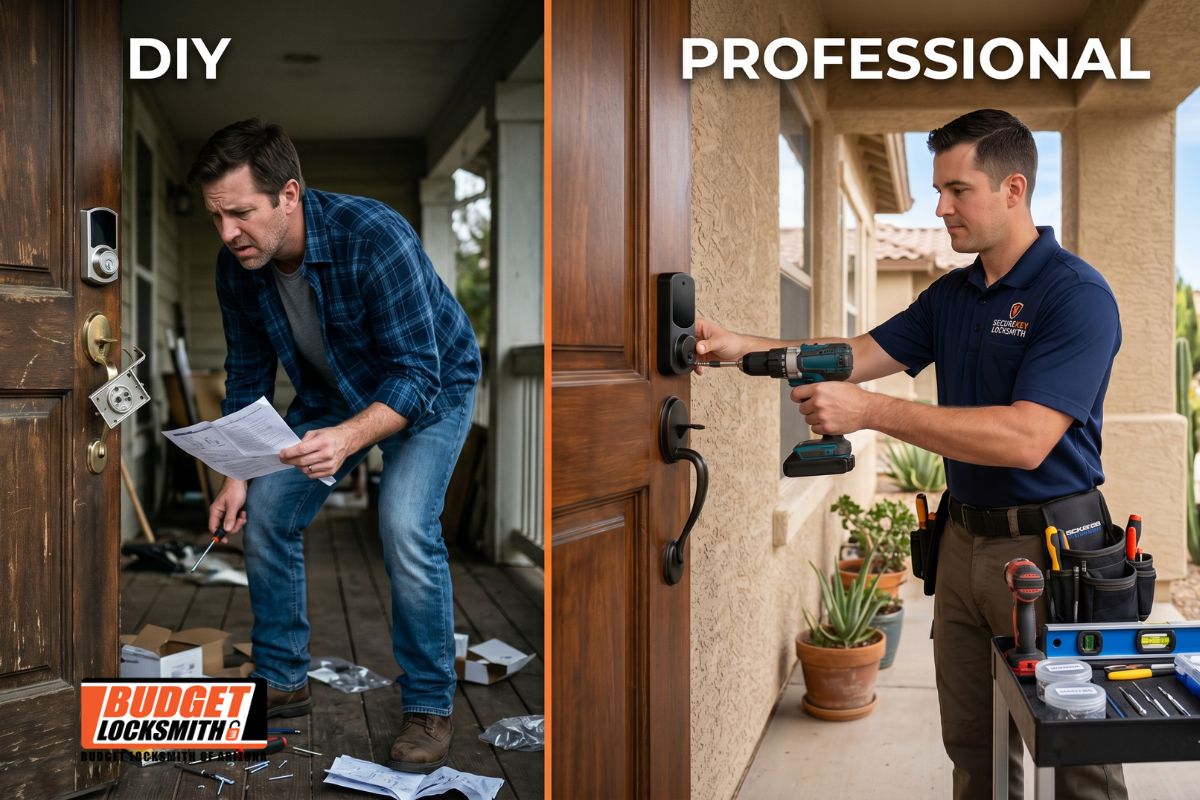
Smart lock installation in Arizona homes frequently fails due to door alignment issues, strike plate misfit, and Wi-Fi bridge placement errors — not the device itself. Misaligned deadbolts bind the motor, UV-degraded weather seals shift the door position, and thick metal strike plates block Bluetooth pairing. A licensed locksmith evaluates the door geometry, wiring, and network setup before installing.
Most homeowners in the Valley reach a point where the old deadbolt just feels dated — the key sticks, the thumbturn wobbles, and the idea of managing codes from a phone sounds like the right upgrade. The problem is that a smart lock is only as good as the installation underneath it. Even a premium device fails when the door sags, when the strike plate misaligns by a few millimeters, or when the battery compartment sits against a metal frame that kills the signal.
The solution is knowing when a DIY retrofit actually works and when a professional locksmith belongs on the job. At Budget Locksmith of Arizona, we install, troubleshoot, and replace smart locks across the Phoenix metro every week, and we see the same preventable mistakes over and over again. You can also see our location and reviews on Google Maps — the feedback from local homeowners across the Valley tells you how we work before you even call us.
Keep reading to learn where DIY makes sense, where it doesn’t, and what matters most for real deadbolt security once the new hardware is on the door.
Why Smart Lock Installation Is More Technical Than It Looks
A smart lock is not a standalone gadget. It replaces a working mechanical system — the deadbolt, the latch, the strike plate, the tailpiece, and the alignment between all of them. When any of those components is off, the motor inside the smart lock has to fight the door, and that fight drains batteries, strips gears, and eventually leaves you locked out of your own home.
Arizona homes add a layer that buyers from outside the region underestimate. Summer temperatures regularly climb past 110°F, and that heat cycles through doors every single day. Wood frames expand, metal strike plates shift, and the weather seals around the jamb compress unevenly. A deadbolt that closed perfectly in March may bind by July. When a smart lock is asked to drive a binding deadbolt, its internal motor works harder and fails sooner. Our residential locksmith team sees this pattern across every corner of the Valley, from Phoenix to Scottsdale to Chandler.
The Components That Determine Success
Before the smart lock ever comes out of the box, five things decide whether the installation will hold up:
- Deadbolt throw length — the bolt must extend fully into the strike without friction
- Strike plate alignment — off by more than 1/8 inch and the motor will grind
- Door sag — older doors drop at the hinges and push the bolt out of position
- Tailpiece orientation — the flat piece that connects the lock to the bolt must match the new mechanism
- Wi-Fi or Bluetooth signal path — metal frames, thick stucco, and distance from the router all interfere
None of these show up in the manufacturer’s instruction booklet, but every one of them decides whether the lock lasts ten months or ten years.
Where DIY Smart Lock Installation Works Fine
We will tell you honestly — plenty of smart lock installations don’t need a locksmith. If you’re replacing a recent deadbolt with a well-known brand like August, Schlage Encode, or Yale Assure on a newer door that closes cleanly, and you’re comfortable using a screwdriver and a phone app, the installation is reasonable DIY territory. The door alignment is already correct, the strike plate is already seated, and the existing hardware gives the new lock a stable platform to mount on.
The moment any variable changes, the risk goes up. Older door, custom finish, double-cylinder deadbolt, commercial-grade entry, smart lock paired to an integrated home system — each of those turns a straightforward swap into a job where one small error cascades into repeated lockouts. Our about page explains the training our technicians complete, and it’s specifically designed to handle these cases that fall outside the DIY range.
Where Professional Installation Pays for Itself
Here’s the side-by-side we give homeowners when they ask us to help them decide. This is based on hundreds of installs across Arizona — not a manufacturer’s marketing sheet.
DIY vs. Professional Smart Lock Installation
| Factor | DIY Installation | Professional Installation |
|---|---|---|
| Door alignment check | Skipped or estimated | Measured and corrected |
| Strike plate reinforcement | Original hardware reused | Upgraded if security requires |
| Deadbolt security grade | Depends on purchase | Verified against ANSI Grade 1 or 2 |
| Tailpiece compatibility | Guessed | Matched to manufacturer specs |
| Thumbturn lock interior fit | Often loose | Tightened and tested |
| Network pairing | Self-taught via app | Configured for signal strength |
| Warranty on labor | None | Covered by the locksmith |
| Common outcome | Motor wear, dead batteries, lockouts | Clean operation, longer device life |
The difference compounds over the life of the lock. A motor fighting a misaligned bolt burns through batteries in weeks instead of months, and the repeated mechanical stress shortens the device’s lifespan by years. Our service areas page shows every neighborhood our mobile team covers, and the techs who arrive bring the alignment tools most homeowners don’t own.
Real-World Situations That Need a Pro
- The door is more than 15 years old or has visible sag
- The existing deadbolt binds, sticks, or requires force
- You’re upgrading from a single-cylinder to a double-cylinder smart lock
- Your home has a high-security cylinder or a commercial-grade entry
- The smart lock needs to integrate with an alarm system or access control
- You’ve already tried the install and the lock keeps disconnecting
What Our Locksmiths Actually Do On Site
When one of our technicians arrives for a smart lock installation, the first fifteen minutes are diagnostic — not mechanical. We check the door swing, measure the deadbolt backset, confirm the strike plate position, and test the existing latch under load. We look at the thumbturn lock on the interior to see how cleanly it rotates, and we inspect the frame for signs of stress or prior forced entry. Only after that evaluation do we open the new hardware.
We then dial in the alignment. That can mean shimming the strike, adjusting the hinges, reinforcing the jamb, or resetting the tailpiece so the bolt throws without resistance. Once the hardware operates cleanly by hand, we mount the smart lock, pair it with the homeowner’s app, and walk through home safety basics — user codes, auto-lock timing, tamper alerts, and battery replacement cycles. Every install we complete is documented through our contact and booking process and backed by a written warranty on parts and labor.
Pro Tip from the Field
If you’re going to DIY anyway, do this one thing before you buy the lock: close your current deadbolt slowly and listen. If you hear metal-on-metal scraping or you have to lift the doorknob to turn the key, your door is misaligned. Installing a smart lock on a misaligned door is the single fastest way to kill the motor. Fix the alignment first — or call us for a quick evaluation — before the new hardware arrives.
Frequently Asked Questions
Can I install a smart lock myself on an older door?
On a door older than 15 years, we recommend a pro evaluation first. Frame shift, hinge sag, and strike plate wear are common on older Arizona homes, and each one forces the smart lock motor to work harder than it should. A short on-site check catches those issues before the new hardware is committed to the door.
Do smart locks hold up in Arizona heat?
Quality smart locks from established brands handle the heat well when they’re installed on a properly aligned door. The issues we see almost always trace back to installation — not the device. Shaded door positions and Grade 1 or Grade 2 hardware are the two biggest factors in how the lock ages.
Will a smart lock improve my overall home safety?
Yes, when the hardware grade matches the risk profile of your home. A smart lock adds user codes, auto-lock features, and tamper alerts, but the underlying bolt still has to meet a solid security standard. We help homeowners pair the right deadbolt grade with the smart features they actually want.
What happens if the smart lock stops working after install?
If we installed it, we come back and make it right under our warranty on parts and labor. If a DIY install fails, we can usually diagnose and correct the underlying alignment issue on the same visit so the lock runs cleanly going forward.
Do I need to be home during the installation?
Yes. We require the homeowner or an authorized adult on site, and we verify identification and proof of ownership before any residential lock work begins. It’s a standard safety practice that protects everyone involved in the job.
Which smart lock brands do you recommend?
We install and service most major brands — Schlage, Yale, August, Kwikset, and several higher-security options. The right choice depends on your door, your network setup, and whether the lock needs to integrate with any existing home system. We walk through the fit on site before any hardware is opened.
Making the Right Call
The decision between DIY and a professional locksmith comes down to three things: the age of your door, the grade of the lock you’re installing, and how much downstream trouble you’re willing to accept if something goes wrong. A newer door and a consumer-grade smart lock rarely need help. An older door, a premium lock, or a smart lock tied into wider home systems almost always do.
For homeowners across the Valley, we’re the team to call when the install matters more than the shortcut. Budget Locksmith of Arizona has been handling residential smart lock work for over a decade. Our technicians are licensed, insured, and bonded, and every job carries a written warranty on both parts and labor. The reviews on our Google Maps listing reflect what our clients across Phoenix and the surrounding cities already know — we show up with the right tools, we explain the work before we start, and we don’t leave until the lock operates cleanly.
If your smart lock project involves anything beyond a simple swap — or if you’d like a security audit before choosing hardware — give us a call or find us on Google Maps to book a site visit. If you found this useful, you might also want to read our related guide on rekeying vs replacing locks for the next decision most homeowners face. Call Budget Locksmith of Arizona today to schedule your consultation, and let our certified technicians handle the part of the job that decides whether your new smart lock lasts ten months or ten years.