

Most homeowners in the Phoenix metro don’t think about their door locks until something goes wrong — a lock that sticks in the July heat, a door that no longer latches properly, or a security upgrade that’s long overdue. The type of lock installed on your front, back, or side door determines how protected your home and family actually are. We’ve helped thousands of Arizona homeowners assess, upgrade, and install the right hardware, and the single most common issue we see is the wrong lock in the wrong application.
Understanding the different types of door locks — from basic knob locks to high-security deadbolts and modern thumbturn systems — puts you in control of a decision that directly affects your home safety. Our licensed locksmiths serving the Phoenix metro area walk through this topic daily, and we’ve put together this guide so you can make an informed choice before calling a professional — or know exactly what to ask when you do.
We’ve verified our local presence and customer reviews on Google if you want to see what Arizona homeowners say about our work before reading further.
The Most Common Door Lock Types — And What They Actually Protect Against
Most homes in Arizona have at least one of the following five lock categories installed. The problem is that many were chosen for convenience or aesthetics — not security. Here’s what each type offers and where it falls short.
Knob Locks
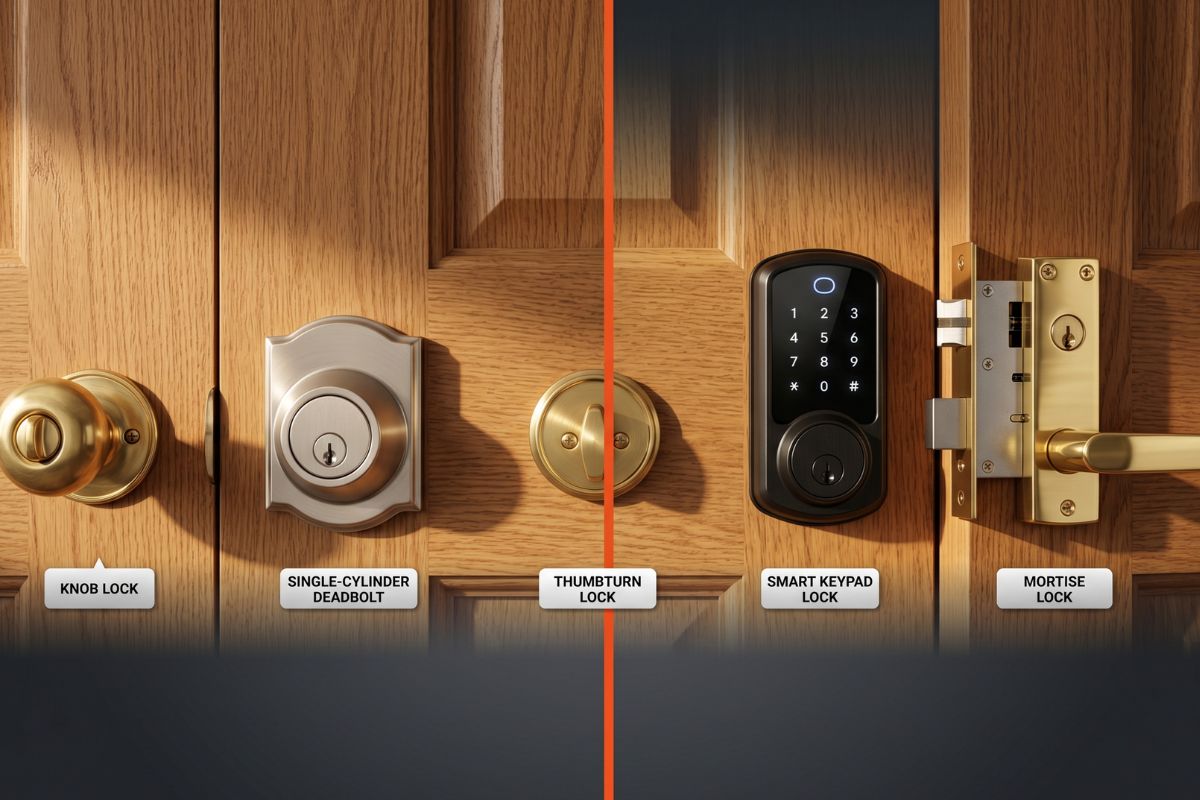
Knob locks are the most frequently installed — and most frequently bypassed — lock type in residential settings. The locking mechanism lives inside the knob itself, which makes them fast to install and inexpensive to replace. However, because the cylinder is exposed on the exterior side, a determined intruder can break or twist the knob off with basic tools and gain entry without touching the lock mechanism at all.
In Arizona’s extreme summer heat, knob lock hardware — especially low-grade zinc alloy versions — expands and contracts with daily temperature swings between 70°F mornings and 115°F afternoons. That thermal cycling degrades internal spring components faster here than in most other states. We regularly replace knob lock hardware that has failed structurally after just two or three Arizona summers.
Knob locks should never be used as a primary exterior lock. They work as secondary locks on interior doors — bedroom doors, office doors, bathroom entries — where forced entry is not the primary concern.
Deadbolt Security Locks
Deadbolts are the standard for residential exterior door security, and for good reason. Unlike spring-bolt locks that retract when pressure is applied, a deadbolt extends a solid steel bolt into the door frame’s strike plate, which must be forced back manually. There is no spring — the bolt only moves when the cylinder is turned.
The two most common deadbolt configurations are:
- Single-cylinder deadbolt — Keyed on the exterior, thumbturn on the interior. The most common configuration in Arizona homes. Fast egress from inside, standard key operation from outside.
- Double-cylinder deadbolt — Keyed on both sides, with no thumbturn. Used on doors with glass panels near the lock, since an intruder can’t reach through broken glass and simply turn a thumbturn to open the door.
Deadbolt security depends heavily on the grade of hardware. ANSI/BHMA rates deadbolts on a three-grade scale — Grade 1 being commercial-level security, Grade 3 being residential builder-grade. Most homes come equipped with Grade 2 or Grade 3. An upgrade to Grade 1 deadbolt hardware can significantly increase resistance to kick-in attacks and picking.
Our technicians are trained to evaluate not just the lock itself but the strike plate and door frame around it. A Grade 1 deadbolt installed into a door frame with a standard 3/4-inch strike plate held by 3/4-inch screws is only marginally more secure than a knob lock — the weak point is the frame, not the bolt.
| Lock Type | Security Level | Best Application | Forced Entry Resistance | AZ Heat Performance | Install Complexity |
|---|---|---|---|---|---|
| Knob Lock | Low | Interior doors only | Poor — shear attack risk | Moderate — zinc degrades fast | Simple |
| Single-Cylinder Deadbolt | High | Primary exterior doors | Very Good — solid bolt | Good — steel expands minimally | Moderate |
| Double-Cylinder Deadbolt | High | Doors with glass panels | Excellent — no thumbturn bypass | Good | Moderate |
| Thumbturn Lock | Medium | Standard entry, no glass nearby | Good — frame-dependent | Good | Moderate |
| Lever Handle Lock | Low | Interior / ADA compliance | Poor — not for exterior solo use | Variable — plastic warps in heat | Simple |
| Handleset (with Deadbolt) | Medium–High | Front entry doors | Good — integrated deadbolt | Good with brass/stainless internals | Moderate–Complex |
| Smart Lock (Keypad/App) | Medium–High | Primary entry, tech households | Good — retains deadbolt bolt | Check temp rating for AZ heat | Moderate |
| Mortise Lock | Very High | High-security residential/commercial | Excellent — full-depth embed | Excellent — all-metal build | Complex — pro required |
| Padlock (Short Shackle) | Medium | Sheds, gates, storage units | Good — minimal exposed shackle | Good — stainless/hardened steel | Simple |
Thumbturn Locks, Levers, and Handlesets: What Homeowners Often Overlook
The Thumbturn Lock
A thumbturn lock refers to the interior-side actuator found on single-cylinder deadbolts and many knob locks. It’s the oval or bar-shaped component you rotate with your thumb and index finger to extend or retract the bolt from inside the home. Thumbturns are convenient — no key needed for exit — but they introduce a specific vulnerability.
When a door has glass sidelights or a window panel within 40 inches of the lock, a thumbturn lock can be reached by breaking the glass. In these cases, our residential locksmith team typically recommends switching to a double-cylinder deadbolt or installing a secondary surface-mounted bolt positioned away from the glass.
Lever Handle Locks
Lever handle locks are the ADA-compliant alternative to round knob locks. The lever design requires less grip strength to operate, making them standard in commercial environments and increasingly popular in residential settings. Like knob locks, lever locks house the locking mechanism inside the handle body and should not be used as a primary security device on exterior doors without a supplemental deadbolt.
In Arizona’s heat, lever handles with plastic internals soften and sometimes bind after prolonged sun exposure — particularly on west-facing doors that receive direct afternoon sun. We recommend lever hardware with solid brass or stainless steel internal components for exterior applications.
Handleset Locks
A handleset combines a decorative exterior grip, a latching mechanism, and a deadbolt into a single hardware unit. They’re common on front entry doors and give a polished finished look without requiring separate installation of a knob and a deadbolt. The security quality of a handleset varies widely based on the deadbolt cylinder integrated into the unit. High-end handlesets from brands like Schlage, Baldwin, and Kwikset Signature Series integrate Grade 1 cylinders; economy handlesets from big-box stores typically include Grade 3 or unrated cylinders.
Smart Locks and Electronic Door Locks
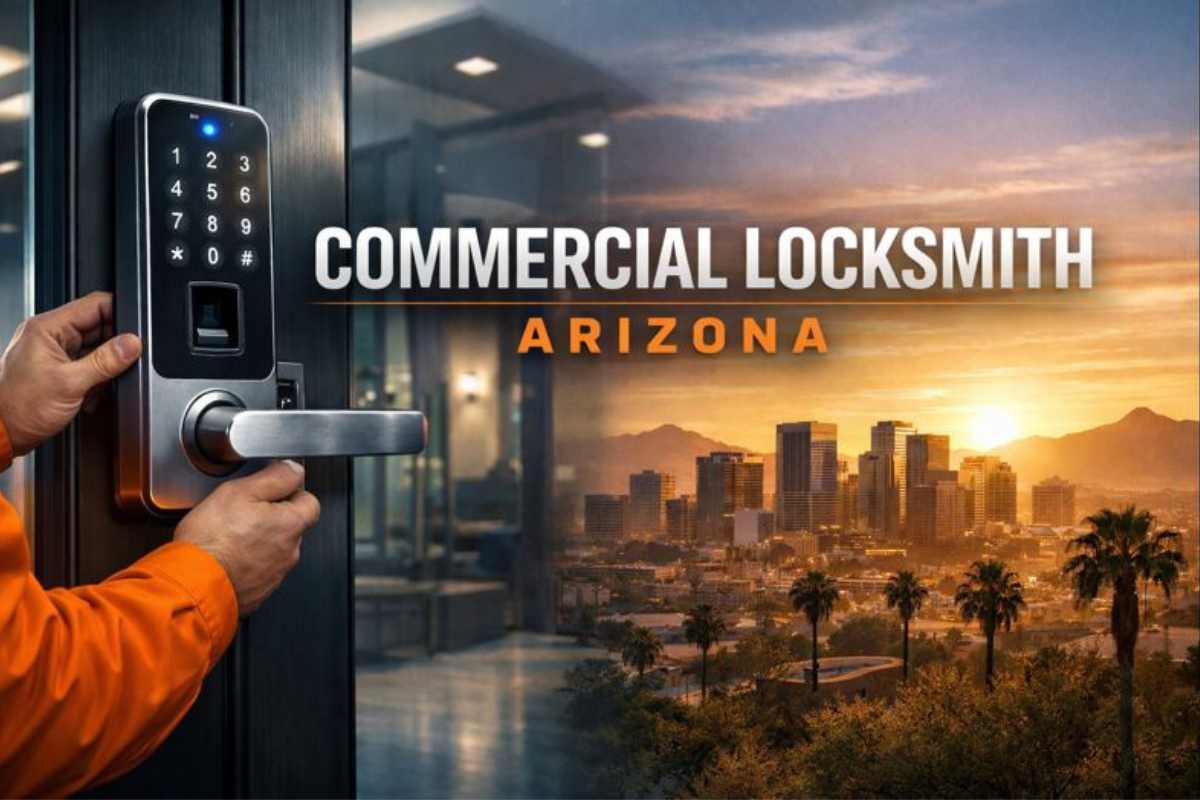
Smart locks have moved from a novelty to a legitimate security tool in the last five years. They replace the traditional keyed cylinder with an electronic actuator controlled by keypad code, smartphone app, biometric fingerprint, or all of the above. The deadbolt mechanism itself — the steel bolt extending into the frame — remains functionally the same. What changes is how that bolt is controlled.
For Arizona homeowners, smart locks present one significant environmental concern: heat. Electronics installed on south- or west-facing doors can reach internal temperatures that exceed manufacturer operating ranges during peak summer months. We’ve serviced smart lock failures during Phoenix summers caused entirely by thermal damage to internal circuit boards.
When we install smart locks, we evaluate door orientation, direct sun exposure, and manufacturer temperature ratings before recommending a specific model. Our home security services include orientation-specific installation guidance — not just hardware swapping.
The most common smart lock types we install in the Phoenix area include:
- Keypad deadbolts — No key required; entry via numeric code. Battery-powered. Simple and low-maintenance.
- Wi-Fi connected smart locks — App-controlled from anywhere; allows temporary code creation for guests or contractors.
- Bluetooth proximity locks — Unlock when your smartphone comes within a set distance. Fast, but limited to close-range control.
- Z-Wave / Zigbee smart locks — Integrate with broader smart home systems (Amazon Echo, Google Home, ADT Pulse).
Mortise Locks: The High-Security Standard
Mortise locks are installed inside a carved-out pocket (the “mortise”) within the door body itself, rather than through a hole drilled in the face. They’re the most durable residential and commercial lock type available, and they’ve been the industry standard in commercial buildings for over a century.
Because the lock body is embedded in the door, mortise locks distribute the stress of an attack across the full door thickness rather than concentrating it at a single point. They combine a latch bolt, a deadbolt, and often a chain or auxiliary bolt in a single unit. Our licensed and bonded locksmith technicians are trained in mortise lock installation and repair — a more complex procedure than standard deadbolt installation because it requires precise routing of the door pocket.
Mortise locks are an excellent upgrade choice for homeowners in Scottsdale, Tempe, Chandler, or any Phoenix suburb where property values and home security standards are high. They’re also the right call for any door that has seen repeated kick-in attempts or forced entry damage.
Padlocks and Secondary Locking Hardware
Padlocks are portable locks that don’t permanently attach to a structure. They’re available in laminated steel, solid brass, stainless steel, and hardened steel shackle configurations. For home security purposes, padlocks are most relevant on storage sheds, gates, garages, and exterior storage units.
Shackle length matters. A long shackle leaves more exposed steel that can be cut with bolt cutters. Short-shackle or “hockey puck” padlocks — named for their squat, circular shape — minimize exposed shackle and are significantly more cut-resistant.
We also install door barricade bars, surface-mounted rim locks, and sliding door security bars as secondary locking hardware on patio doors and vulnerable entry points. In many of the residential locksmith calls we handle across Mesa, Gilbert, Peoria, and Glendale, sliding glass patio doors have either no secondary security or only the factory latch — which can be lifted out of the track with minimal effort.
How Arizona’s Climate Affects Lock Performance and Lifespan
This is a topic most out-of-state lock guides never cover — but it directly affects every homeowner in the Phoenix metro area. Arizona’s desert environment creates conditions that accelerate hardware wear in specific ways:
- UV degradation breaks down rubber seals and plastic components inside keypad locks and smart lock housings faster than in any other U.S. climate zone
- Thermal expansion causes metal deadbolt cylinders to bind in the door frame during peak afternoon heat, making locks feel stiff or difficult to turn
- Fine desert dust infiltrates cylinder pins and spring mechanisms, gradually increasing operating resistance and eventually causing cylinder failure
- Monsoon humidity spikes followed by rapid dry-out can cause wooden door frames to swell and contract, misaligning strike plates and deadbolt throws
We recommend annual lock maintenance for all exterior hardware in Arizona — a professional cleaning, lubrication with PTFE or graphite (never WD-40), and alignment check that extends lock life significantly. This is a service we provide across the entire Phoenix metro area.
Pro Tip: Evaluate Your Strike Plate Before Upgrading Your Lock
Many homeowners invest in a Grade 1 deadbolt and stop there — but the weakest point in most door assemblies isn’t the lock, it’s the strike plate mounting. Standard builder-grade strike plates use 3/4-inch screws that bite into the door stop molding, not the structural door frame behind it. A solid kick can split that molding and bypass even the best deadbolt in under two seconds.
The fix is straightforward: a heavy-duty reinforced strike plate (ANSI Grade 1 rated, 16-gauge steel minimum) installed with 3-inch screws that penetrate through the door stop and into the structural stud behind the frame. This single upgrade — which takes our technicians about 20 minutes — can be more effective than replacing the entire lock assembly. It’s one of the first things we assess on any home security consultation we conduct.
Frequently Asked Questions About Door Lock Types
Making the Right Call for Your Home
The right door lock depends on the door, the application, the surrounding hardware, and the specific security profile of your home — not just the price tag on the box. A $15 knob lock on a front door is not a security device. A $90 Grade 1 deadbolt installed into a weak frame offers false confidence. Real deadbolt security comes from matching quality hardware to a correctly reinforced door and frame assembly.
If you’re in the Phoenix metro area — Scottsdale, Tempe, Mesa, Chandler, Gilbert, Glendale, Peoria, or any surrounding community — our team at Budget Locksmith of Arizona is licensed, insured, and bonded to handle any residential lock evaluation, installation, or upgrade. Our technicians carry Grade 1 deadbolts, mortise hardware, smart lock kits, and reinforced strike plate sets on every service vehicle, so most installations are completed in a single visit.
We’re frequently asked about related topics too — if you want to go deeper on a specific decision, our post on rekeying vs. replacing locks covers a question that comes up in nearly every lock upgrade conversation we have.
Budget Locksmith of Arizona has built its reputation across the Phoenix area through transparent pricing, honest assessments, and technicians who treat your home with the respect it deserves. You can verify our reputation and find us on Google Maps before you call — we stand behind every review.
Ready to assess or upgrade your door locks? Contact us at Budget Locksmith of Arizona and schedule a residential security evaluation. We’ll assess every entry point, identify vulnerabilities, and recommend only what your home actually needs — no upselling, no pressure. Visit our local Google listing to confirm our service area, read customer feedback, and reach us directly.