




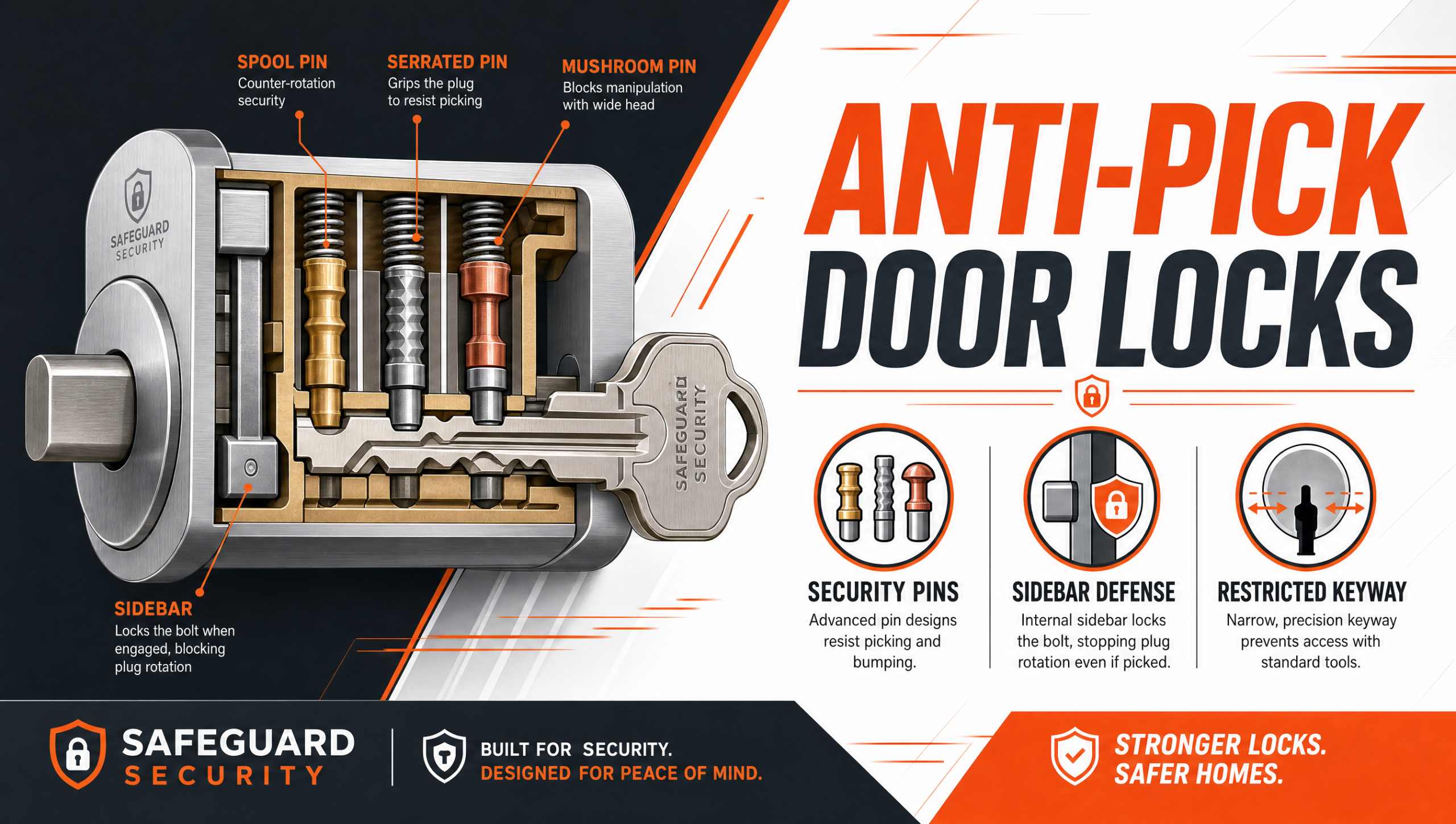
Anti-pick door locks use specially engineered security pins, internal sidebars, and restricted keyways that resist the manipulation techniques skilled intruders depend on. Instead of letting a tension wrench and pick set quietly turn the cylinder, these locks feed false feedback into the burglar’s hands and force mistakes — which is exactly why trained criminals tend to give up and search for an easier target.
Most front doors across the Phoenix metro still rely on a basic pin-tumbler cylinder, and an experienced intruder can manipulate that design without leaving a single scratch. The encouraging part is that anti-pick door locks close that gap with hardened internal components built to defeat picking and bumping. As a licensed Phoenix locksmith team that has serviced thousands of homes across the Valley, we have seen how the right cylinder changes the entire equation. Read on to learn how these locks work, what separates them from standard hardware, and how to choose the right level of protection for your home.
What Makes a Lock “Anti-Pick”?
A standard cylinder works on a simple idea: a row of spring-loaded pins has to line up perfectly at the shear line before the plug can rotate. A picker applies light turning pressure with a tension wrench, then nudges each pin until it sets at that line one by one. On ordinary hardware, this is a learnable skill. Anti-pick engineering interrupts the process at the source, and understanding the difference is the foundation of real residential security.
Security Pins That Mislead the Picker
The heart of any pick-resistant cylinder is its driver pins. Manufacturers replace standard cylindrical pins with spool, serrated, and mushroom pins. These shapes catch at the shear line and send a false signal that a pin has set when it actually has not. The picker feels a “click,” eases off, and the plug rotates slightly into a false set — trapping the mechanism in a state that has to be unwound from scratch. Each false set adds another layer of confusion, and on a quality cylinder there are several pins working against the intruder at once.
Sidebars and Restricted Keyways
Higher-grade locks add a sidebar: a secondary locking bar that must align independently of the pin stack, often controlled by finger pins or a magnetic element the pick can never reach. Many also use restricted keyways with patented profiles, so blanks are controlled and cannot be duplicated at a hardware kiosk. This is the same principle behind a professional master key system, and it means key control stays in the homeowner’s hands. If you are comparing hardware, our guide to the different types of door locks breaks down where each grade fits.
| Security Feature | Standard Pin-Tumbler Lock | Anti-Pick Door Lock |
|---|---|---|
| Pin design | Plain cylindrical driver pins | Spool, serrated & mushroom security pins |
| Pick resistance | Low — opens with basic tools | High — false sets stall manipulation |
| Bump-key vulnerability | Susceptible to bumping | Engineered to resist bumping |
| Sidebar mechanism | None | Independent sidebar adds a second barrier |
| Key control | Blanks copied at any kiosk | Restricted, patented keyways |
| Drill resistance | Minimal | Hardened pins and anti-drill plates |
| ANSI/BHMA grade | Often Grade 3 | Typically Grade 1 |
| Visible deterrent value | Low | Recognizable high-security face |
| Best fit | Interior & low-risk doors | Exterior entries & high-exposure doors |
Why Anti-Pick Door Locks Deter Experienced Burglars
Skilled intruders work on probability, not persistence. They favor entries that yield with predictable effort and a low chance of being noticed. Anti-pick door locks flip that math. The false sets created by security pins waste the picker’s effort, the sidebar refuses to cooperate, and the restricted keyway removes the option of a copied key. Faced with a cylinder that resists every familiar method, an experienced burglar reads the situation and moves on rather than committing to a struggle in plain view.
There is also a visible deterrent at play. A recognizable high-security face plate signals that the homeowner invested in real protection, and that signal alone discourages an opportunist before they ever touch the door. Pairing that hardware with a documented home lock change after a move, a lost key, or a tenant turnover keeps the advantage on your side. When clients ask us about upgrading after a break-in attempt, we often walk them through rekeying versus replacing locks so the decision matches their actual exposure, and for those who prefer to keep their existing hardware we can simply rekey the locks to a fresh key. Business owners face the same logic, which is why a commercial security lock upgrade is one of our most requested services across the Valley.
Where Deadbolt Security and Thumbturn Locks Fit
A pick-resistant cylinder is only as strong as the bolt behind it. Deadbolt security depends on a solid bolt throw, a reinforced strike, and a frame that can hold under force. We recommend an ANSI/BHMA Grade 1 deadbolt, certified to the standards published by the Builders Hardware Manufacturers Association, as the baseline for an exterior door. Many premium cylinders are also tested against the UL 437 high-security standard, which evaluates resistance to picking and drilling.
The thumbturn lock on the interior side adds convenience for exits but introduces a consideration near glass: a thumbturn within reach of a broken sidelight can be turned by hand. In those layouts we fit a captured or keyed thumbturn so the inside is protected too. If your existing bolt is worn or misaligned, our replace deadbolt walkthrough and our lock repair and adjustment service restore the mechanical strength an anti-pick cylinder needs to perform. Proper door lock alignment matters just as much, because a bolt that drags will never seat fully.
A Pro Tip From Our Field Experience
Here is the lesson we share on nearly every home safety assessment: a pick-resistant cylinder mounted on a weak frame is only half a lock. The most common failure we find is a strike plate held by short screws that bite only into the door jamb’s thin trim. Before spending on a high-security cylinder, replace those screws with three-inch versions that anchor into the wall stud, and add a reinforced strike box. A kicked-in door does not care how clever the pins are. We also suggest pairing the upgrade with window lock installation and, for households moving toward keyless entry, a high-security electronic deadbolt that keeps the same mechanical resistance behind a coded face.
Frequently Asked Questions
What are anti-pick door locks and how are they different from standard locks?
Can anti-pick door locks be picked at all?
Do I need a special key for an anti-pick lock?
Will an anti-pick cylinder fit my existing door?
How does deadbolt security work alongside an anti-pick lock?
Are thumbturn locks a security risk near glass?
Strengthening Your Home’s First Line of Defense
Choosing the right cylinder is one of the highest-return decisions a homeowner can make, and it rewards a careful, informed approach rather than guesswork. Every door has a different frame, exposure, and history, which is why our certified technicians evaluate the full opening — bolt, strike, frame, and keyway — before recommending a grade. If you found this useful, our breakdown of interior door lock installation is a natural next step for protecting rooms beyond the entry, and homeowners weighing electronic options can review what goes into a proper smart lock installation. You can also explore the full range of our residential locksmith services in Arizona to see how anti-pick hardware fits a complete security plan.
When you are ready to harden your entry points, our licensed and trained team is here to help across Phoenix and the surrounding Valley. Reach out through our contact page or call (623) 288-0222 to schedule a security assessment, and visit us on our Google Maps listing to see why Phoenix homeowners trust Budget Locksmith of Arizona for stronger, smarter door security.