




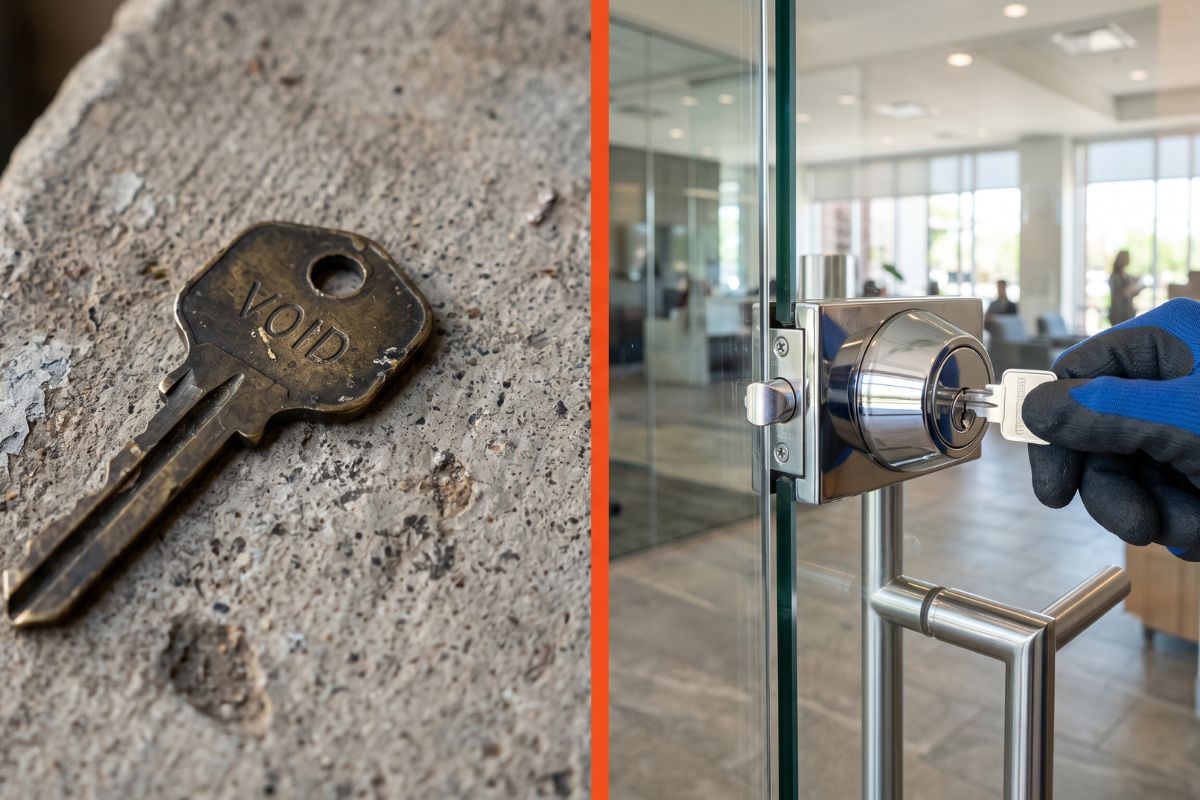
Commercial lock rekeying is one of the most overlooked security decisions a business owner makes — and one of the most consequential. When your company moves into a new commercial space, you have no way of knowing how many key copies the previous tenant made, who has them, or where those keys ended up. The solution is not complicated: commercial rekeying services change the internal pin configuration of every existing lock so that old keys stop working entirely — without replacing the hardware. If you just signed a lease and you’re wondering what to do first, keep reading. We’ll walk you through exactly why commercial lock rekeying belongs at the top of your to-do list.
Every commercial building passes through multiple tenants, contractors, property managers, cleaning crews, and maintenance workers over the years. Each of those parties may have received a key — and not all of them returned it. Budget Locksmith of Arizona has seen this scenario play out repeatedly across the Phoenix metro area: a business moves in, skips rekeying, and later discovers a theft or unauthorized access that traces back to an old key copy. Find us on Google Maps to see what other Arizona business owners say about our commercial locksmith work.
Our licensed technicians serve businesses throughout the Valley — from downtown Phoenix to Scottsdale, Tempe, Mesa, and Chandler. Our commercial locksmith services in Phoenix are designed around one goal: making sure your business starts with a clean, documented, and controlled access system.
What Commercial Lock Rekeying Actually Does
Most business owners assume that getting new keys from the property manager is enough. It isn’t. The property manager hands you the keys they have — but they can’t account for copies made by every contractor, subcontractor, or former employee who ever accessed the space.
Rekeying a commercial lock involves removing the lock cylinder from the door hardware and replacing the internal pins — the small spring-loaded components that determine which key profile operates the lock. Once the new pin configuration is set, only the new keys we cut for you will work. Every key that previously opened that lock becomes permanently inactive.
This process works on standard deadbolt locks, knob locks, lever handles, and most commercial-grade cylindrical locks. We document every cylinder we rekey and provide you with a key control record — something no property manager can offer.
Commercial Rekeying vs. Lock Replacement: A Side-by-Side Look
One of the first questions we hear from new tenants is whether they should rekey or replace the locks entirely. The answer depends on the condition of the hardware, the security grade of the existing locks, and your budget. The table below breaks down the key differences.
| Factor | Commercial Rekeying | Full Lock Replacement |
|---|---|---|
| What Changes | Internal pins only — hardware stays | Entire lock cylinder and hardware |
| Old Keys | Permanently deactivated | Permanently deactivated |
| Security Upgrade | Access control reset; no hardware upgrade | Higher-grade hardware available |
| Hardware Condition | Existing hardware remains in place | Worn or damaged hardware replaced |
| Key Control System | New documented key set issued | New documented key set issued |
| Best For | New tenants, employee turnover, lost keys | Damaged hardware, security grade upgrade |
| Disruption to Business | Minimal — most cylinders done in minutes | Moderate — door hardware removed and reset |
| Recommended By | Licensed locksmiths, insurance carriers | Licensed locksmiths when hardware is compromised |
For most businesses moving into a new space, commercial rekeying is the right starting point — especially when the existing hardware is in good condition and meets commercial-grade standards. If your locks are showing wear, misalignment, or are below Grade 2, our team will recommend commercial lock replacement during the same visit.
The Risks of Skipping Commercial Rekeying
We’ve responded to enough commercial lockout calls and post-break-in security assessments in the Phoenix area to say this clearly: skipping rekeying after a move-in is one of the most common and most preventable security gaps we see.
Former Tenants and Their Key Copies
Commercial spaces in Phoenix often cycle through multiple tenants within a few years. A retail location, office suite, or warehouse that’s been occupied for a decade could have key copies distributed to a dozen parties — former employees, after-hours cleaning services, HVAC technicians, IT vendors, and prior sublease holders. Property managers are required to provide you with the keys they have, but they have no legal obligation — and no ability — to account for every copy that was ever made.
Employee Turnover and Lost Keys
Even within your own organization, key control breaks down quickly. If a former employee doesn’t return a key, or a key is lost without being reported, your lock is compromised from that moment forward. Our commercial rekeying service resets that entire history in a single visit. Many of our commercial clients in Glendale, Peoria, and Tempe schedule rekeying annually as a standard part of their security protocols — not just at move-in.
The Insurance Angle
Some commercial property insurance policies include clauses related to access control documentation. In the event of a theft, your insurer may ask for evidence that you took reasonable steps to secure the property. A documented rekeying record from a licensed locksmith — something we provide with every commercial job — is exactly the kind of paper trail that supports a claim.
How We Approach Commercial Rekeying in Arizona
Our licensed locksmith team handles commercial rekeying jobs across the Phoenix metro area with a structured process. We don’t show up with a one-size-fits-all approach. Every building is different.
Step 1: Access Audit
Before touching a single lock, one of our technicians walks the property with you and identifies every keyed entry point — front doors, back doors, deadbolts, interior office locks, storage rooms, and server closets. We log each cylinder by location and current key type.
Step 2: Hardware Evaluation
We check every lock cylinder for wear, damage, and security grade. If any hardware is below Grade 2 commercial standard, we flag it and present your options. Deadbolt installation can happen during the same visit if needed — no second appointment required.
Step 3: Pinning and Key Cutting
Our technicians carry a full pinning kit and key-cutting equipment in every service vehicle. We repin each cylinder on-site, cut your new key set, test every key in every lock, and provide a documented record of every cylinder we serviced.
Step 4: Master Key System Setup (Optional)
For businesses that need tiered access — where a manager key opens all doors but an employee key only opens specific areas — we can set up a master key system during the same visit. This is especially useful for office suites, multi-unit retail spaces, and warehouse facilities.
When Else Should You Rekey Your Commercial Locks?
Move-in day isn’t the only trigger. Our commercial locksmith clients in the Phoenix area contact us for rekeying in several other situations:
- After an employee departure — particularly a manager or anyone with unsupervised key access
- After a lost or unreturned key — reported or suspected
- After a break-in or attempted forced entry — even if the lock held, it should be evaluated
- After a vendor or contractor relationship ends — especially if they held a key
- After a security audit reveals access control gaps
- When adding new access points — new office doors, server rooms, or exterior gates
If any of these apply to your current situation, contact our team to schedule a commercial security evaluation. Our home security page also covers residential rekeying if you need both services addressed at the same time.
Pro Tip: Establish Key Control from Day One
One of the most overlooked practices in commercial security is key control documentation. From the moment you take possession of a space, you should know exactly how many keys exist, who holds each one, and what doors each key accesses.
We recommend creating a simple key log — a spreadsheet or a physical ledger — that records every key issued, the employee or contractor who received it, the date it was issued, and the date it was returned. This is especially important for master key systems or any environment with restricted access areas.
When we complete a commercial rekeying job, we provide a written record of every cylinder serviced and every key cut. That document becomes the starting point for your key log. Keeping it current costs nothing and saves significant headaches during employee turnover or security incidents.
Frequently Asked Questions About Commercial Lock Rekeying
What to Look for in a Commercial Locksmith
Not every locksmith that handles residential work is equipped for commercial jobs. Commercial locks operate at higher security grades, involve larger key systems, and often require coordination with property managers, building codes, and tenant agreements.
Our team at Budget Locksmith of Arizona is licensed, insured, and bonded by the state of Arizona. We carry ALOA-aligned training standards and work strictly from documented job records — meaning you always have a paper trail. Our technicians are background-checked, arrive in marked vehicles, and carry company-issued identification. We verify identity before beginning any job.
You can review our work and our customers’ experiences directly on our Google Business profile, where you’ll find detailed reviews from business owners across the Phoenix metro. Transparency is part of how we operate — from the access audit to the final key handoff.
We’re also part of the local business community. If you’re comparing options, ask any locksmith for proof of their Arizona license, their insurance certificate, and their key control documentation process. If they can’t produce those on the spot, look elsewhere.